
Mohave County Directory Collections
The verified shelf begins with three separate R. L. Polk volumes for Kingman. They are not a continuous run. The State of Arizona Research Library supplied the source books, FamilySearch International digitized them, and the Arizona Memory Project provides the online collection. Each volume must be searched as its own snapshot. The wider research trail includes newspapers, maps, census schedules, a professional directory, and local archival material. Those sources serve different roles. A newspaper may explain a move or death, while a Sanborn sheet can confirm a building footprint but not its occupants.
| Historical set | Verified dates | Keeper | How to consult it |
|---|---|---|---|
| Kingman Polk volumes | 1937, 1961, 1963 | State Research Library | Free Arizona Memory Project PDFs |
| Mohave County Miner | 1882-1918 collection; later title lineage | Arizona Digital Newspaper Program | Free name and date search |
| Kingman Sanborn maps | 1890-1923 editions; corrections through 1948 | ASU and Library of Congress | ASU index; free 1916 images |
| Federal census | Public through 1950 | NARA and library platforms | Library genealogy access |
| Museum research material | Dates vary by collection | Mohave County Historical Society | Appointment with volunteer staff |
The Arizona Memory Project collection browser shows the three-volume Kingman set.
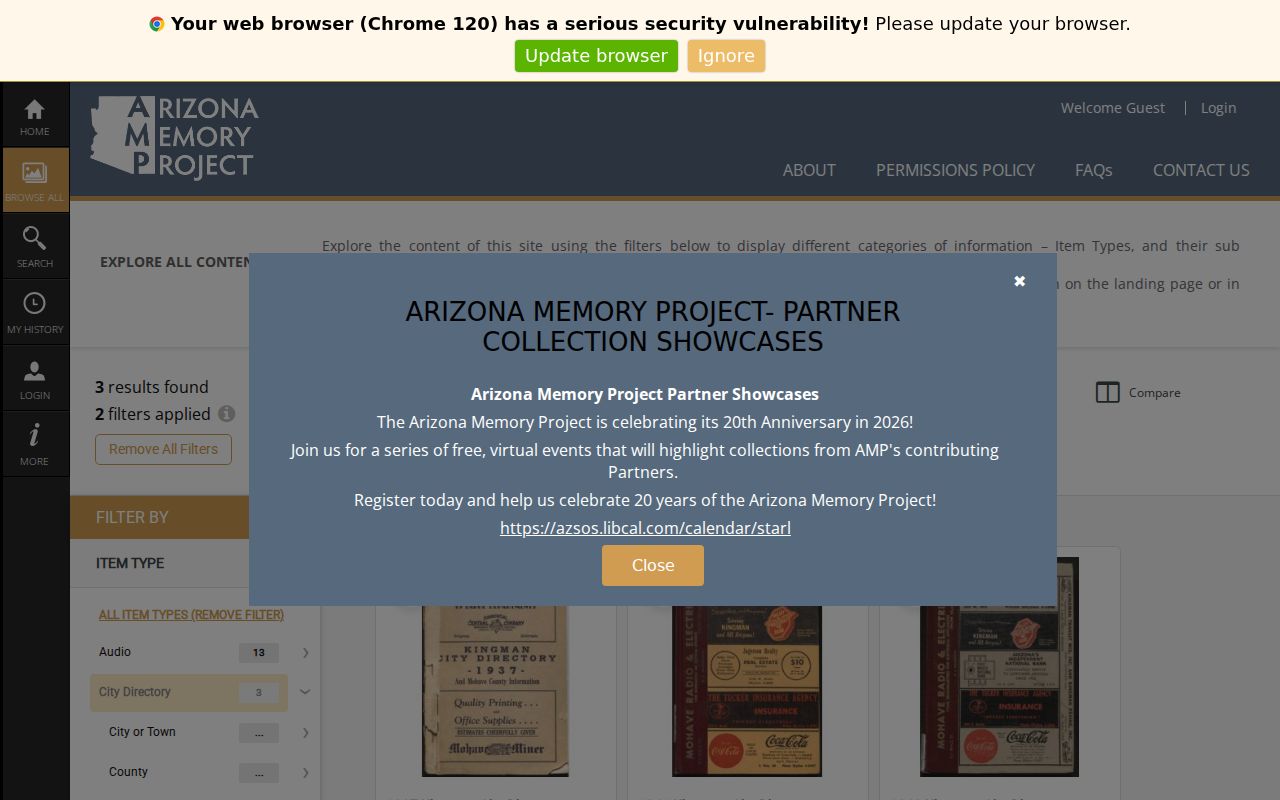
The collection view is the safest place to confirm that 1937, 1961, and 1963 are discrete editions rather than a full span.
Three Kingman Directory Years
The 1937 volume can be paired with the 1940 census, creating a close comparison between a publisher's canvass and a federal household schedule. The 1961 and 1963 books form a short postwar sequence. Since 1950 is the newest public federal census as of 2026, later deeds, obituaries, newspapers, and civic records must bridge those two books to later events. The 1937 and 1963 catalog records carry call numbers 917.91DC K549 1937 and 917.91DC K549 1963. Those citations help staff distinguish the exact book when a link or title is ambiguous.
Scope also matters. The collection proves Kingman coverage. It does not prove that Bullhead City, Lake Havasu City, Colorado City, or every unincorporated community appears. Check each title page and coverage note before claiming a countywide entry. No authoritative local reverse-directory, telephone-book, school-yearbook, church-register, or funeral-register run was published in the reviewed sources. A gap should remain a gap until a repository confirms a volume.
Note: A missing Kingman entry may reflect spelling, nonresponse, rural limits, a move, or death rather than confirmed absence.
Reading Mohave County Directory Entries
Begin with the abbreviation page. The catalog made the PDFs available, but a clear sample entry could not be verified for every Kingman edition. Therefore, do not assume that all common Polk symbols appear in all three books. Transcribe only what the chosen volume prints. Capture the page image and record the displayed name, spouse or household notation, occupation, employer or business tie, residence address, and any owner, renter, or widow mark that the book actually defines.
| Printed field | Preserve the exact spelling, initials, punctuation, and word order. |
|---|---|
| Household clue | Record a spouse or other relationship only when the entry states it. |
| Work clue | Keep the occupation and named business separate from the home address. |
| Street clue | Copy the number and street as printed, then check later maps or deeds. |
| Status mark | Use an owner, renter, boarder, or widow mark only after reading that volume's key. |
Each entry freezes one canvass. It is evidence that a person was listed, not a legal finding of residence. Names, routes, and house numbers can change between editions.
- Criss-cross directory
- A directory arranged by street or address rather than only by surname. Confirm that the chosen book actually contains this section.
- Householder index
- An address-ordered list that can connect a house number to the person printed there.
- Abbreviation key
- The book's own legend for shortened trades, street terms, and status marks. It controls how an entry should be read.
Mohave County Catalog Myth
Myth: every date field in a digital catalog must agree. The 1963 Kingman item does not. Its title and call number identify a 1963 directory, while one metadata field says “Date Original 1961.” This is a catalog anomaly, not proof that the two volumes are the same. Cite the displayed title, call number, item URL, and the page used. Preserve the conflict in research notes instead of silently choosing the convenient date.
Catalog key. Treat descriptive metadata as a finding aid. The scanned title page and the cited page supply the evidence used in a family history.
The distinction guards against false timelines. If a person changes address or occupation from 1961 to 1963, merging the editions could erase the very change the search was meant to find. A careful Mohave County city directory citation keeps both the catalog record and the scanned page.
Trace Mohave County Directory Families
A household trail works best as a chain of dated observations. Start with the directory closest to a known event. Keep surname variants and initials separate until an address, spouse, occupation, deed party, or obituary joins them. Then move outward to a census year or a nearby edition. This method reduces the risk of merging two people who share a name.
- Search surname variants in 1937. Save the page, printed address, occupation, and household marks.
- Compare the result with the 1940 census. Match several facts, not the name alone.
- Search 1961 and 1963 separately. Note every change in address, spouse notation, and trade.
- Use deeds and newspapers after the 1950 public-census limit. Keep owners distinct from listed occupants.
- Close a disappearance with an obituary, probate file, later directory, or documented move when available.
The Mohave County Library research page lists in-library Ancestry Library Edition, HeritageHub obituary and death-notice coverage from 1704 to the present, and Internet Archive genealogy links.

Licensed access differs by tool. Ancestry is available only inside the library, while remote databases can require a valid library card.
Mohave County Directory Gaps
The Mohave County Miner collection supplies names between directory dates. The paper began at Mineral Park on November 5, 1882, and moved to Kingman when the county seat shifted there in 1887. It combined with Our Mineral Wealth in 1918, while the title lineage continued through 1974. Search marriages, deaths, business notices, court notices, social columns, and advertisements. Each item gives context, but a business mention is not proof of a home address.
The 1951-1953 Arizona Business and Professional Directory fits between the later public census and the two postwar Polk volumes. It names Kingman public officials, businesses, churches, the Chamber, Eagles, and VFW entries, with addresses or post-office boxes. Use these as public roles and affiliations. A post-office box locates mail, not a household.
Note: Search the newspaper by name, date range, and known community because the county-seat move can place early notices outside modern Kingman references.
Maps Beside Mohave County Directories
Sanborn fire-insurance maps answer questions the directory cannot. The ASU index lists Kingman editions from 1890, 1896, 1898, 1901, 1910, 1916, and 1923, with corrected material through 1948. The Library of Congress offers the March 1916 five-sheet set. A sheet can show a building footprint, use, construction detail, and historic street label. It cannot name the person who lived there.
Pair a mapped lot with a directory entry and a deed legal description. If the house number or street text shifts, the legal description may preserve continuity. Modern parcel and address research belongs in the Mohave County by-street directory; the historic map serves here only as context for a dated listed occupant.
Mohave County Archive Insider Tip
Insider tip: the Mohave Museum Research Library is appointment-only and volunteer-run. Its thousands of manuscripts, maps, photographs, and documents make it the best verified local fallback for pre-digital work, but its public request text does not publish a full shelf list or dependable fee schedule. Contact staff with a narrow question. Supply the surname, community, address or legal description, and a date window.
The Mohave Museum research facility describes the local history collection and appointment access.

Ask about city, telephone, or reverse directories, newspaper microfilm, vertical files, maps, photographs, school annuals, cemetery or funeral files, manuscript indexes, and copy rules. The request is a search lead, not proof those unlisted holdings exist.
Mohave County Directory Timeline
Mohave County's changing county seats explain why an early name may surface far from the current Kingman record desk. The official chain moved from Mohave City to Hardyville, Cerbat, Mineral Park, and then Kingman. The newspaper followed the seat from Mineral Park, linking public events and community notices across the change.
| Date | Directory context |
|---|---|
| 1864-1887 | County custody moved through four seats before Kingman. |
| 1882 | The Mohave County Miner began at Mineral Park. |
| 1887 | Kingman became the seat, and the newspaper moved there. |
| 1937 | The earliest verified digitized Kingman Polk volume in the three-book set. |
| 1961 and 1963 | The two verified postwar Kingman Polk snapshots. |
This timeline does not imply lost records. No authoritative evidence of a courthouse fire or flood destroying Mohave County record groups was found. When the online shelf ends, use library staff, the State Research Library, museum appointments, and the office that created the underlying record.